Read the Parking Restrictions
Line colours and regional parking syntaxes can vary. Always defer to local street signage above general guidance.
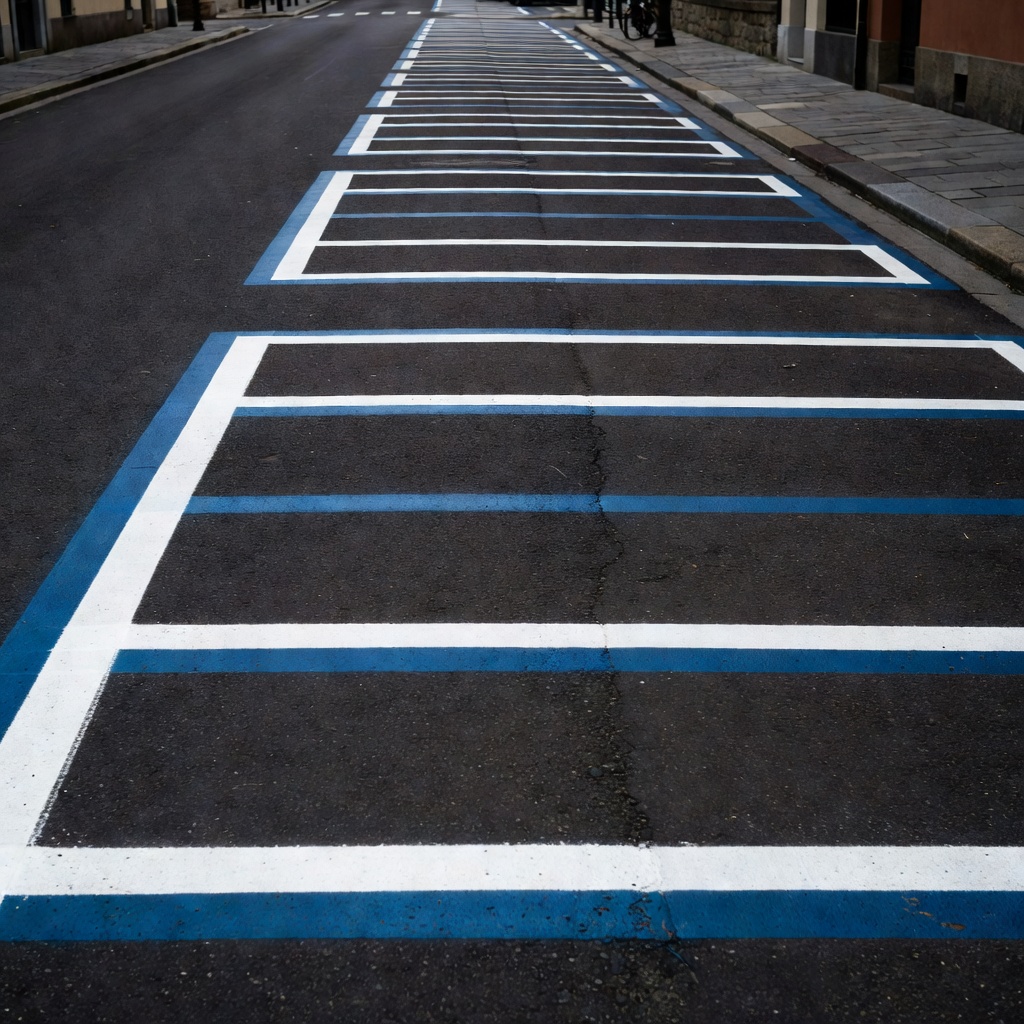
Securing a parking spot in a dense European city is notoriously challenging, but avoiding a parking fine requires an even higher level of vigilance. European parking regulations are communicated through a complex syntax of painted street lines, upright signage, and digital payment zones. Misinterpreting this visual language upon arrival is one of the most common ways travellers incur financial penalties.
The Syntax of Coloured Lines
Across much of Western and Southern Europe, the colour of the lines painted on the road surface dictates the parking rule. While there are regional nuances, a standard framework applies broadly across Italy, Spain, France, and Switzerland.
White Lines: Generally, white lines indicate free parking. However, this is heavily caveated. You must always check nearby upright signs to ensure the spot isn't restricted to specific times of day, street sweeping schedules, or local residents. In some Italian municipalities, white lines are free, but you must display a parking disc to limit your stay.
Blue Lines: Blue lines universally indicate paid parking or time-restricted parking. In paid zones, you must locate a nearby ticket machine (pay-and-display) or use a designated municipal parking app like EasyPark or PayByPhone. In time-restricted blue zones, you do not pay, but you must use a physical blue parking disc.
Yellow and Red Lines: Yellow lines denote areas reserved for specific vehicles—such as disabled badge holders, delivery loading zones, taxis, or local residents. Unless you meet the strict criteria displayed on the signage, parking in a yellow zone is illegal and risks immediate towing. Red lines, used prominently in the UK, signify a strict "no stopping" rule at any time, even to drop off a passenger.
The European Parking Disc (Blue Zone)
The "Zone Bleue" (Blue Zone) is a system used extensively in Germany, France, Switzerland, and Italy to manage short-term parking. To park here, you must use an EU-standard parking disc (a small cardboard or plastic clock face).
Upon arriving in the spot, you turn the dial on the disc to indicate your time of arrival. Most rules require you to round up to the next half-hour mark. You then place the disc visibly on your dashboard. The nearby street sign will stipulate the maximum permitted stay (e.g., 1 hour, 2 hours). These discs can usually be purchased for a few euros at petrol stations, tobacconists, or tourist offices. Failure to display the disc, setting it incorrectly, or overstaying the limit results in a fine.
Digital Parking and Apps
Cash is rapidly disappearing from European parking meters. Many municipalities have transitioned entirely to digital payment systems. Before setting off, it is highly recommended to download the dominant parking applications in your destination country. EasyPark has broad coverage across Scandinavia, Italy, and Spain, while apps like RingGo or JustPark are dominant in the UK.
When using an app, ensure you input the correct zone number found on the street signage and double-check your vehicle's license plate, especially if you are in a rental car. The digital systems are heavily monitored by wardens, and some cities deploy camera-equipped vehicles that scan license plates continuously to check for active digital parking sessions.